In semiconductor manufacturing and handling, electrostatic discharge (ESD) poses a silent threat to integrated circuits (ICs) and chips. Even a small static charge can cause latent or catastrophic damage, leading to yield loss and reliability issues. Utilizing proper ESD-safe chip trays is a fundamental defense. This guide outlines seven key considerations for selecting and using these essential components effectively.
1. Understanding ESD Risks in Chip Handling
Electrostatic discharge occurs when a sudden flow of electricity passes between two objects. In semiconductor contexts, this can happen during routine handling, transport, or storage.
Types of ESD Damage
Damage is not always immediately visible but can be devastating.
Catastrophic Failure: Immediate and complete device failure, often detected during testing.
Latent Defect: A weakened device that fails prematurely in the field, causing reliability problems.
Proper ESD-safe chip trays form a critical part of a comprehensive ESD control program.
2. Material Science: Conductive vs. Dissipative
The tray material's electrical properties determine its level of protection. Two primary categories are used.
Conductive Materials
These materials have low electrical resistance, typically less than 1 x 10^4 ohms.
Provide a path for charge to ground quickly.
Offer shielding against external electrostatic fields.
Used for highly sensitive devices or in high-risk environments.
Dissipative Materials
These have higher resistance, usually between 1 x 10^4 and 1 x 10^11 ohms.
Slowly drain static charge in a controlled manner.
Prevent rapid discharge that could itself cause damage.
Are the most common choice for general semiconductor handling.
3. Key Design Features for Protection
Beyond material, the physical design of the tray influences its ESD safety and functionality.
Cavity Design and Device Security
Pockets must hold chips securely without generating charge.
Snug fit to minimize movement and triboelectric charging.
Rounded edges and smooth surfaces to prevent charge accumulation.
Stackability and Interlocking
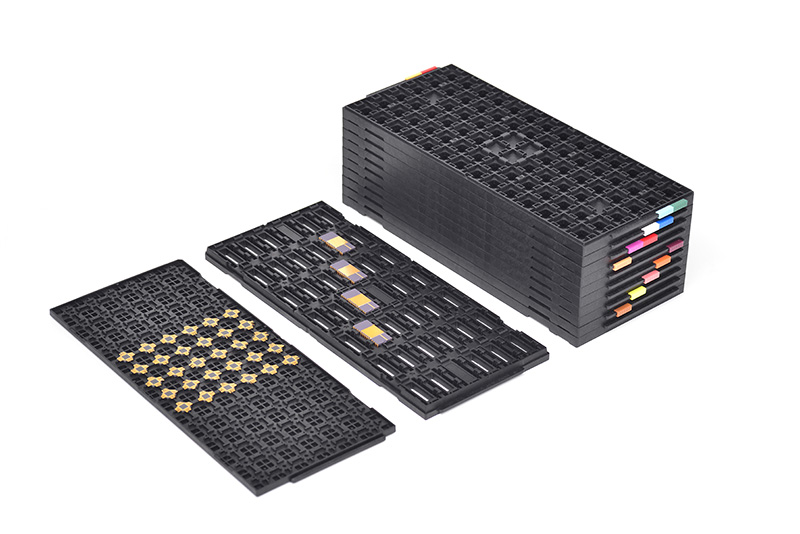
Stackable trays must maintain ESD integrity throughout the stack.
Interlocking features ensure continuous electrical contact between trays.
This creates a shielded pathway, protecting all layers in a stack.
Compatibility with Automation
Trays must work with pick-and-place robots and conveyors.
Precise dimensions for robotic handling.
Features that allow safe transfer without manual contact.
4. Compliance with Industry Standards
Adherence to recognized standards ensures reliability and interoperability.
ANSI/ESD S20.20
This is the global standard for developing an ESD control program. Trays should be certified to meet its material resistance requirements.
JEDEC Standards
Many ESD-safe chip trays follow JEDEC outlines (like MO-048) for dimensional compatibility with automated equipment worldwide.
Supplier Certifications
Reputable suppliers provide test reports and certificates of compliance. Look for data on surface resistance and charge decay performance.
5. Selection Criteria for Your Application
Choosing the right tray requires matching its specifications to your specific needs.
Device Sensitivity (HBM/CDM Ratings)
Consider the Human Body Model (HBM) and Charged Device Model (CDM) sensitivity of your chips. More sensitive devices may require conductive trays.
Operational Environment
Factors like humidity, cleaning chemicals, and temperature ranges affect material performance.
Ensure the tray material is compatible with your cleanroom or factory conditions.
Throughput and Logistics
High-volume lines need durable trays that withstand frequent use. Shipping applications require robust designs with good shock absorption.
6. Integration with ESD-Safe Workstations and Handling
Trays alone are not sufficient. They must be part of a grounded system.
Grounded Work Surfaces
Trays should be used on grounded benches or mats to ensure any charge is safely directed to ground.
Proper Personnel Training
Operators must wear wrist straps and use ESD-safe tools when handling trays and devices.
A holistic approach maximizes the effectiveness of ESD-safe chip trays.
7. Maintenance, Cleaning, and Lifespan
Over time, trays can wear and lose their ESD properties. Proper care extends their useful life.
Cleaning Protocols
Use only recommended cleaners to avoid damaging the tray's surface resistivity.
Isopropyl alcohol or deionized water with lint-free wipes is often safe.
Avoid abrasive cleaners or brushes that can scratch the surface.
Regular Testing and Inspection
Implement a schedule to check tray resistance with a surface resistivity meter.
Replace trays that show signs of wear, cracking, or fall outside resistance specifications.
Supplier Partnership for Consistency
Working with a reliable supplier like Hiner-pack ensures access to consistent quality, technical support, and replacement parts, maintaining your ESD control program's integrity.
Selecting and implementing the correct ESD-safe chip trays is a technical decision with direct impact on product yield and reliability. By focusing on material properties, design features, compliance standards, and proper integration into a controlled workflow, manufacturers can effectively mitigate ESD risks. Partnering with experienced suppliers such as Hiner-pack provides the assurance of quality products that protect valuable semiconductor components throughout the production cycle.
Frequently Asked Questions (FAQs)
Q1: How do I test if my ESD-safe chip tray is still effective?
A1: Use a surface resistivity meter to measure the resistance of the tray material. Follow ANSI/ESD STM11.11 or STM11.12 procedures. Regular testing, such as monthly or quarterly depending on use, is recommended to ensure values remain within the conductive or dissipative range.
Q2: Can I mix trays from different suppliers in the same process?
A2: It is not advisable without validation. Different suppliers may use slightly different material formulations or manufacturing processes, leading to variations in ESD performance and physical dimensions. This can introduce risk. Standardize on one qualified supplier for consistency.
Q3: Are there ESD-safe trays suitable for high-temperature processes like baking?
A3: Yes. Special high-temperature ESD-safe materials, such as certain filled polyphenylene sulfide (PPS) or polyetherimide (PEI) compounds, are available. These can withstand temperatures exceeding 150°C without losing their electrical or structural properties.
Q4: What is the typical lifespan of an ESD-safe chip tray?
A4: Lifespan varies with usage, cleaning frequency, and handling care. Under normal cleanroom conditions, a quality tray can last for hundreds of cycles. Inspect trays regularly for physical damage, wear on contact points, and verify ESD performance to determine replacement timing.
Q5: How do ESD-safe trays differ from antistatic trays?
A5: "Antistatic" is a general term often referring to materials that inhibit triboelectric charging. "ESD-safe" is a more specific performance claim, indicating the material is either conductive or dissipative and is part of a system designed to prevent discharge damage. For semiconductors, always use trays certified as ESD-safe to a specific resistance standard.