Baking Duration and Material Creep Resistance
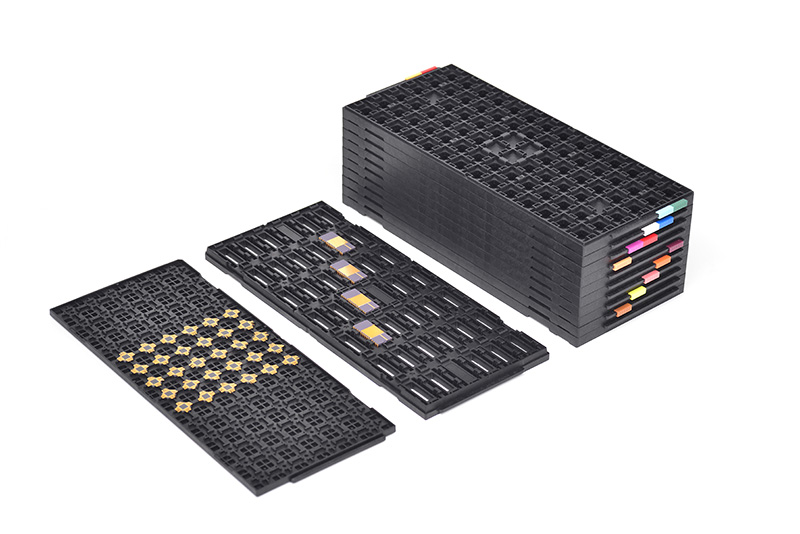
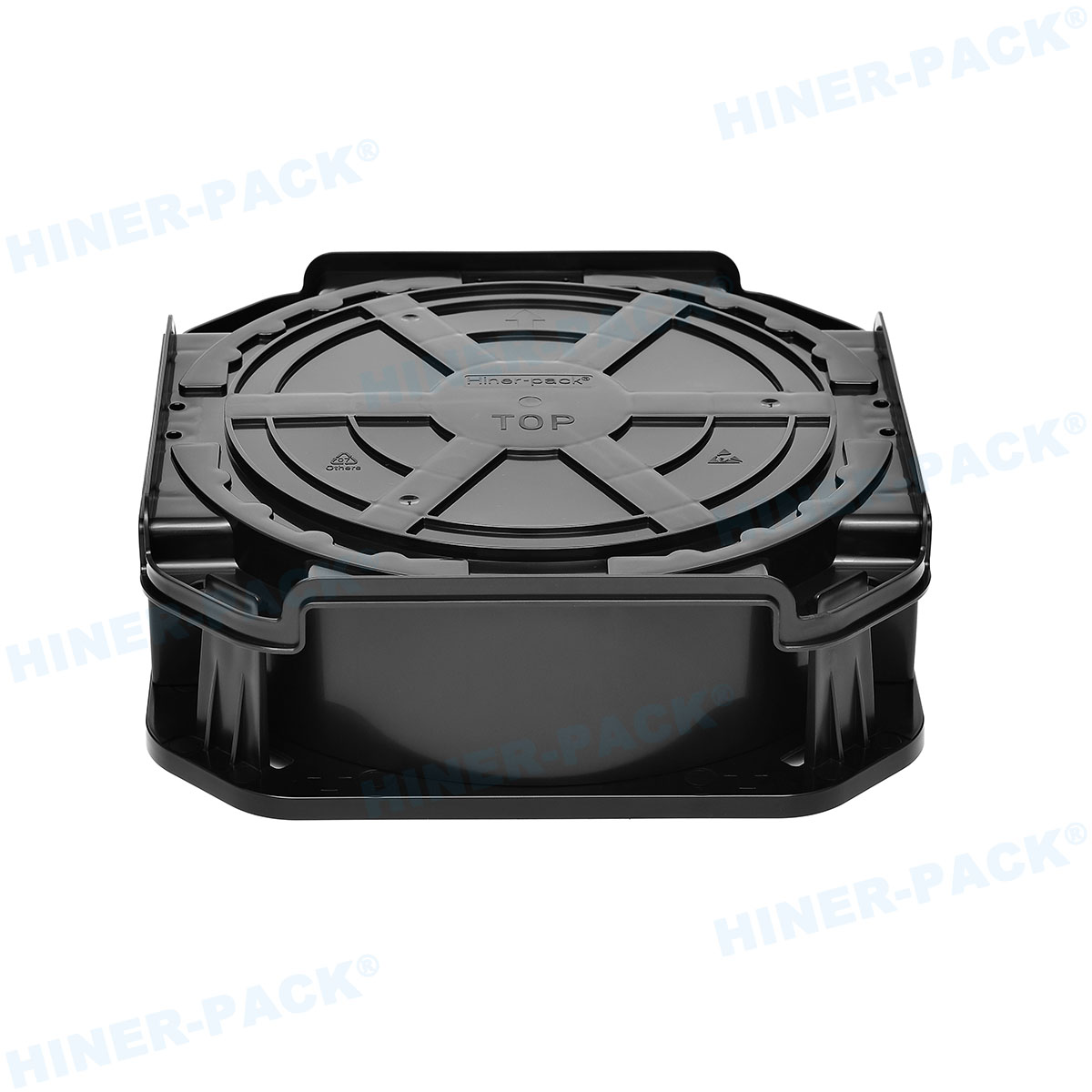
According to JEDEC standards, bakeable trays must undergo 48 hours of continuous baking without violating dimensional tolerances. In practice, baking is often performed at 125∘C to remove moisture from MSL components. However, choosing a tray based solely on a temperature is insufficient. Our engineers prioritize materials like Modified Polyethyleneimine (PEI) or MPPO because of their high Glass Transition Temperatures(Tg). These materials resist "creep"—a slow, permanent deformation under thermal stress—ensuring that the tray maintains its flatness tolerance of within 0.76mm even after multiple cycles, preventing jams in automated elevator mechanisms.
Thermal Hysteresis and CTE Management
Repeated thermal cycling causes Thermal Hysteresis, leading to cumulative shrinkage that can misalign component pockets. Our engineering team optimizes the Coefficient of Linear Thermal Expansion (CTE) by utilizing specialized carbon-fiber or carbon-powder fillers. This provides a structural "skeleton" that stabilizes the tray’s pitch across its 322.6×136mm footprint. By ensuring that shrinkage is minimized, we maintain the precise X-Y location datums required for high-speed pick-and-place nozzles to function without error.
Precision Customization: Pocket Geometry and DFM Logic
While JEDEC defines the external envelope, the internal Pocket Geometry is device-specific. A "one-size-fits-all" approach risks component "wedging" or lead damage. Hiner-pack’s experienced engineers provide expert customization:
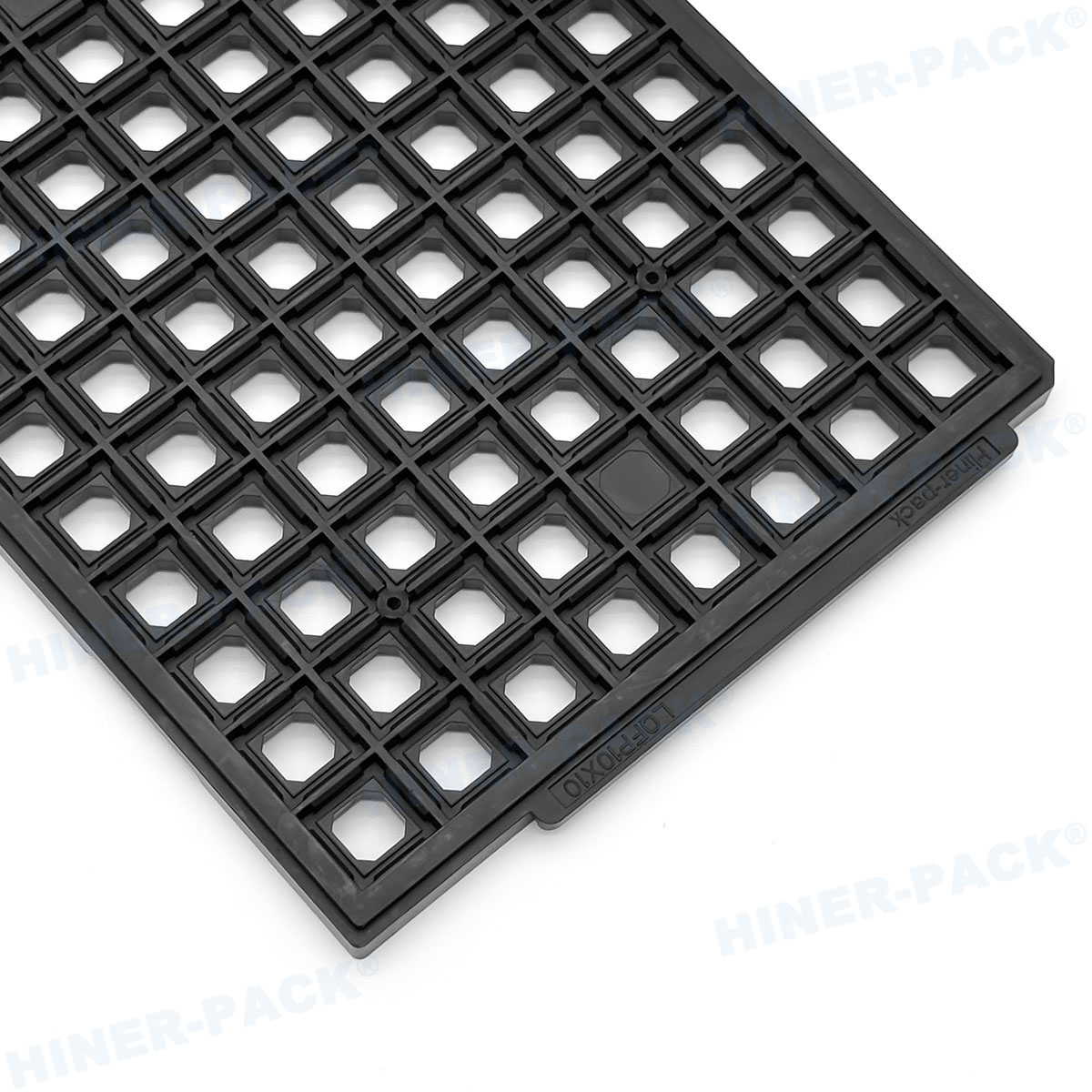
For QFP packages:
Raised pedestals and surrounding fence structures are designed to support and secure the package body, keeping the leads suspended and preventing them from contacting the tray surface. This helps reduce the risk of lead deformation and ensures stable handling in automated pick-and-place processes.
For BGA packages:
Flippable tray designs are often provided, allowing components to be placed in either orientation. This enables convenient solder ball inspection (such as AOI inspection) while maintaining sufficient clearance beneath the ball array to avoid mechanical stress.
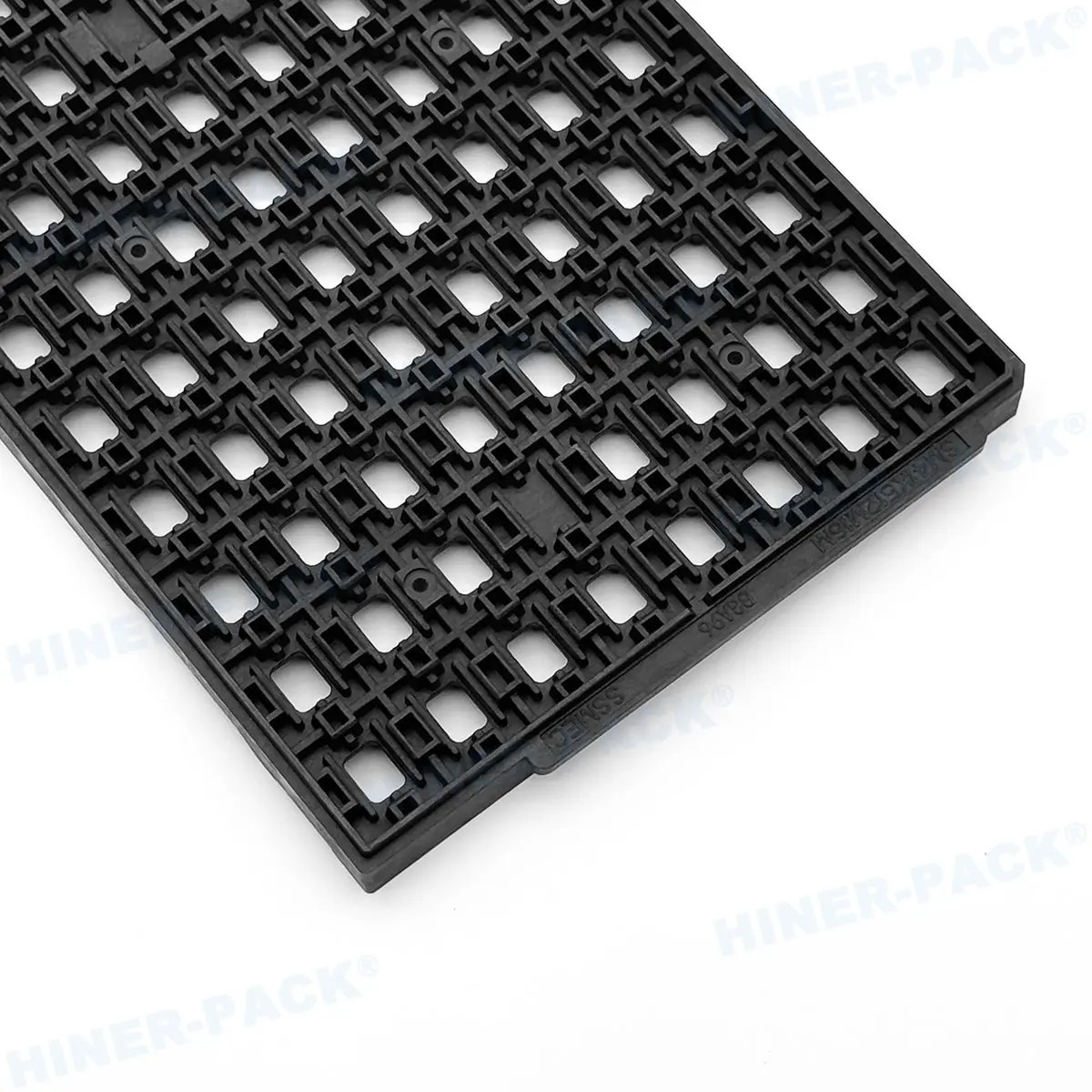
For QFN packages:
A combination of bottom support and side-wall positioning is typically used. Since QFN packages have no protruding leads, the package body can be directly supported from the bottom, while precisely designed cavity dimensions and side walls prevent component movement or rotation during transportation and automated handling.
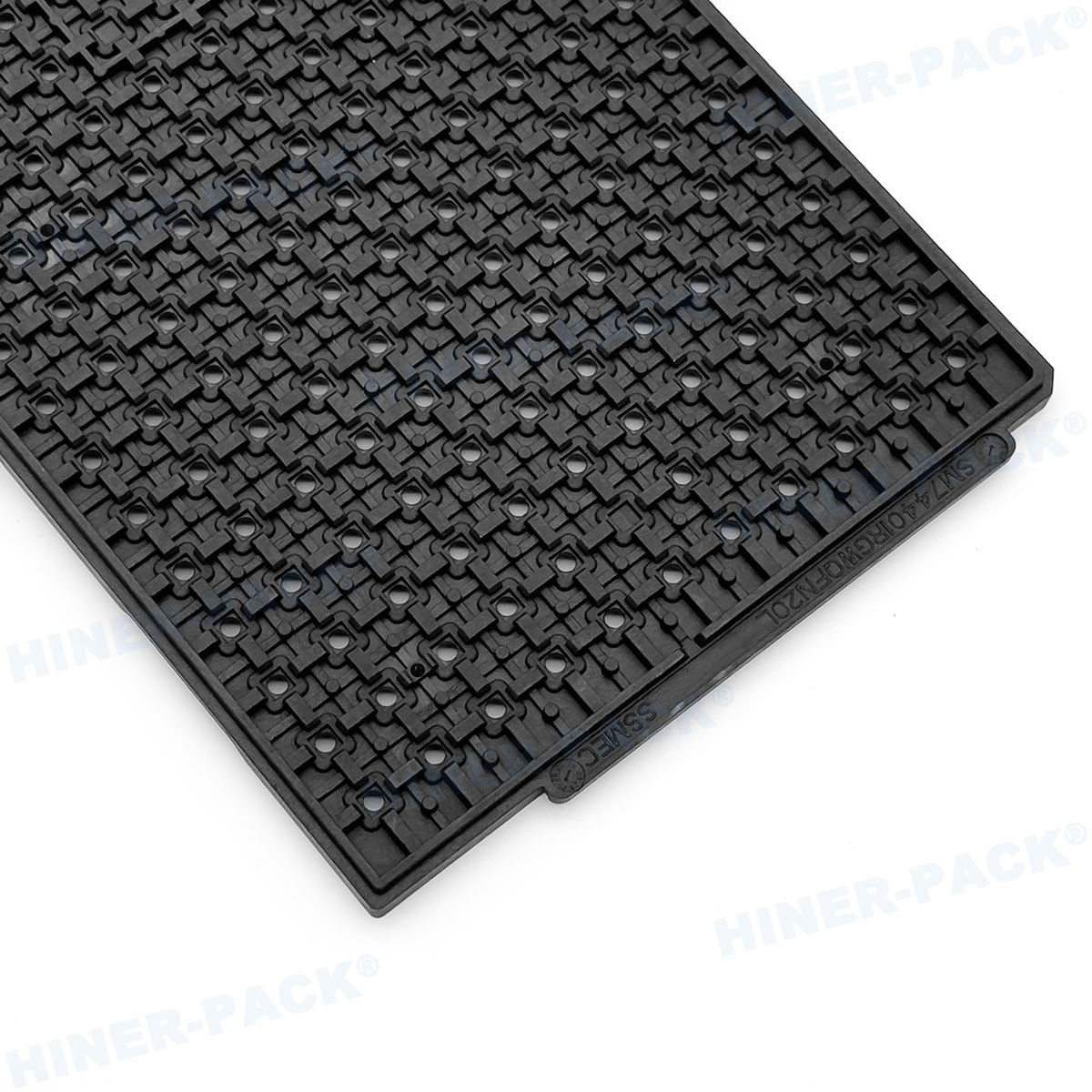
Optimized Pocket Clearance:
The clearance between the pocket and the device is carefully engineered by considering dimensional tolerances and the differences in coefficients of thermal expansion (CTE) between the IC package and the tray material. This ensures that components remain securely positioned without sticking, overlapping, or rotating during transportation, storage, or temperature variations.
Unlike generic off-the-shelf carriers, professional JEDEC trays are typically designed with pocket geometries tailored to specific device packages.
Our engineering team carefully calculates the pocket-to-device clearance to prevent component movement or rotation during transportation and automated handling. This is particularly important because IC packages and tray polymers have different coefficients of thermal expansion (CTE).
The Hiner-pack Engineering Advantage
Beyond being a manufacturer, we are an engineering partner that understands the nuances of automation:
Material Diversity: From cost-effective engineering plastics for shipping to high-performance polymers for 180∘C baking. Whether you require Conductive (Black) trays using carbon fibers for permanent ESD safety, or Anti-static (Colored) ABS trays for non-bakeable transport, we provide the specific resin mix—including proprietary powders for dimensional stability—to match your application's unique requirements.
Orientation Accuracy: Our trays feature the standard 45-degree chamfer for Pin 1 and sculpted scalloped features for mechanical alignment.
Stacking Integrity: Precision-built interlocking features ensure that stacks remain stable during WIP, shipping, and storage in moisture barrier vacuum bags.